
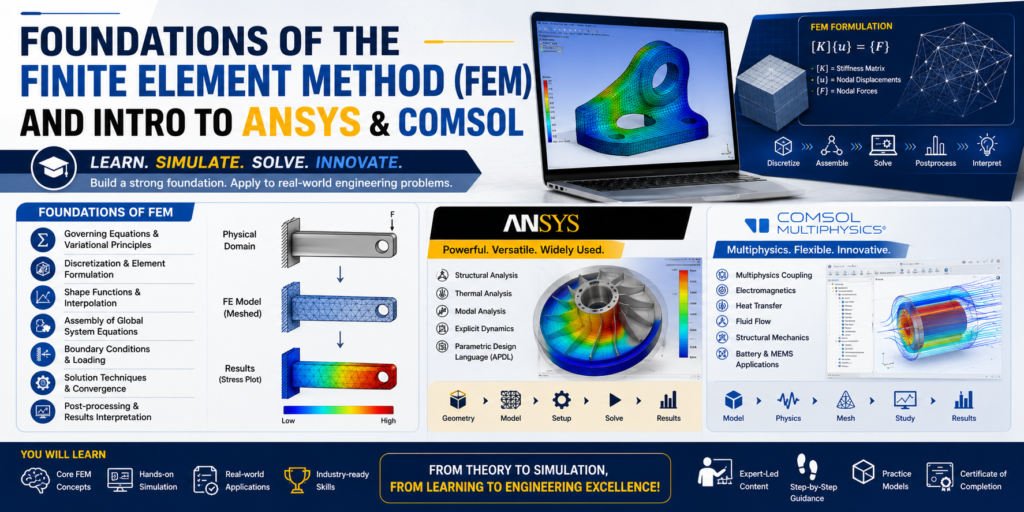
The Finite Element Method (FEM) is a cornerstone numerical technique used across engineering disciplines to approximate solutions for complex partial differential equations (PDEs). Whether analyzing structural deflection, heat gradients, or fluid flow, the foundational workflow remains consistent: discretization (meshing), defining element matrices (stiffness tracking), boundary application, and nodal matrix inversion (KU=F).
This curated collection gathers top-tier books, presentations, design documents, and multi-media courses to guide you from foundational engineering math to introductory execution inside ANSYS and COMSOL Multiphysics.
1. Fundamental FEM Textbooks & eBooks (PDF)
These academic texts explain foundational shape functions, weak variational forms, and stiffness matrix assemblies before jumping into user interfaces.
- Introduction to Finite Element Methods (University of Colorado Boulder): A highly regarded, comprehensive graduate/senior-undergraduate textbook by Carlos Felippa. It covers matrix structural analysis, element formulations, and convergence behavior with deep mathematical rigor.
- An Introduction to the Finite Element Method (J.N. Reddy via ResearchGate): A canonical, globally adopted textbook. This text focuses on weighted-residual methods, variational formulations, and 1D/2D implementation paradigms.
- The Finite Element Method and Applications in Engineering with ANSYS (Springer): An ideal dual-purpose textbook that maps formal structural equations directly into equivalent APDL and Workbench command pathways.
- Introduction to the Finite Element Method (IIT Guwahati): A compact, 25-page foundational handbook explaining domain discretization, shape functions, and element assembly steps.
2. Structural Presentation Slides (PPT / PPTX)
Presentations offer a highly scannable, step-by-step introduction to numerical methods and tool interfaces.
- Finite Element Method Overview on SlideShare: Comprehensive presentation deck explaining preprocessing, solution matrices, post-processing nodes, and common approximation errors.
- Introduction to ANSYS Workbench Presentation: Visually displays the core modular architecture of ANSYS Workbench, detailing how to link CAD geometries directly to structural static solvers.
- Introduction to ANSYS Training Manual (Scribd): An industry-oriented training deck displaying the breakdown between ANSYS Multiphysics, ANSYS Mechanical, and ANSYS Structural licenses.
3. Engineering Digital Notes & Workshop Docs (Word / Web Docs)
These structured engineering notes provide specific, step-by-step instruction sets for laboratory implementation.
- Finite Element Methods R17 Digital Notes (MRCET): A full-semester, lecture-style PDF (easily convertible to Word format) covering 1D truss analysis, quadratic shape functions, and steady-state thermal fin analysis.
- Finite Element Modeling in ANSYS Guide (Scribd): A detailed, document-style workshop guide that runs through creating geometries, mesh verification steps, and setting isotropic or composite material properties.
- ANSYS Mechanical Help Tutorials Manual: The official corporate documentation layout. This manual presents rigorous tutorials on modal analyses, rotordynamics, and geometry load verification.
4. Official Software Training Portals (Websites)
When mastering complex simulation software, referencing official, vendor-maintained web wikis ensures you learn modern user-interface practices.
- Ansys Academic Support & Learning Resources: The main hub for the Ansys Innovation Courses. It offers completely free student access to verified homework modules, step-by-step tutorials, and peer forums.
- Introduction to COMSOL Multiphysics Quick Guide: The comprehensive official startup manual for COMSOL. It details the layout of the Model Builder, Desktop environments, and demonstrates how to orchestrate true multiphysics coupling (e.g., fluid-structure interaction or Joule heating).
5. Comprehensive Video Lectures (YouTube)
Video tutorials are the most practical way to learn software because you can observe exactly where to click for meshes, boundary constraints, and solver flags.
- Introduction to Finite Element Analysis (FEA): 1-Hour Full Course: A brilliant video masterclass summarizing analytical versus numerical models, 1D/2D/3D element selection profiles, and industry best practices to avoid stress singularities.
- Ansys Tutorial: Finite Element Method Core Logic: A software-centric breakdown explaining how Ansys translates physical CAD components into linear stiffness matrix chains (f = k ⋅ u).
- Introduction to Finite Element Method (FEM) for Beginners: Ideal if you want a brief, conceptual primer on compatibility equations, constitutive laws, and the difference between the force and displacement solution methods.
Summary of Software Ecosystems
Before diving into the tutorials, select the appropriate software environment based on your engineering objectives:
┌─────────────────────────────────────────────────────────────┐
│                 COMMERCIAL FEA ENVIRONMENTS                 │
└──────────────────────────────┬──────────────────────────────┘
                               │
       ┌───────────────────────┴───────────────────────┐
       ▼                                               ▼
┌──────────────┐                               ┌──────────────┐
│    ANSYS     │                               │    COMSOL    │
└──────┬───────┘                               └──────┬───────┘
       ├─► Industry Structural Standard               ├─► Pure Mathematical PDE Focus
       ├─► Elite Meshing Controls (Fluent/GMSH)       ├─► Native Multiphysics Matrix
       └─► Hyper-optimized for Aero/Automotive        └─► Exceptional for MEMS/Chemical